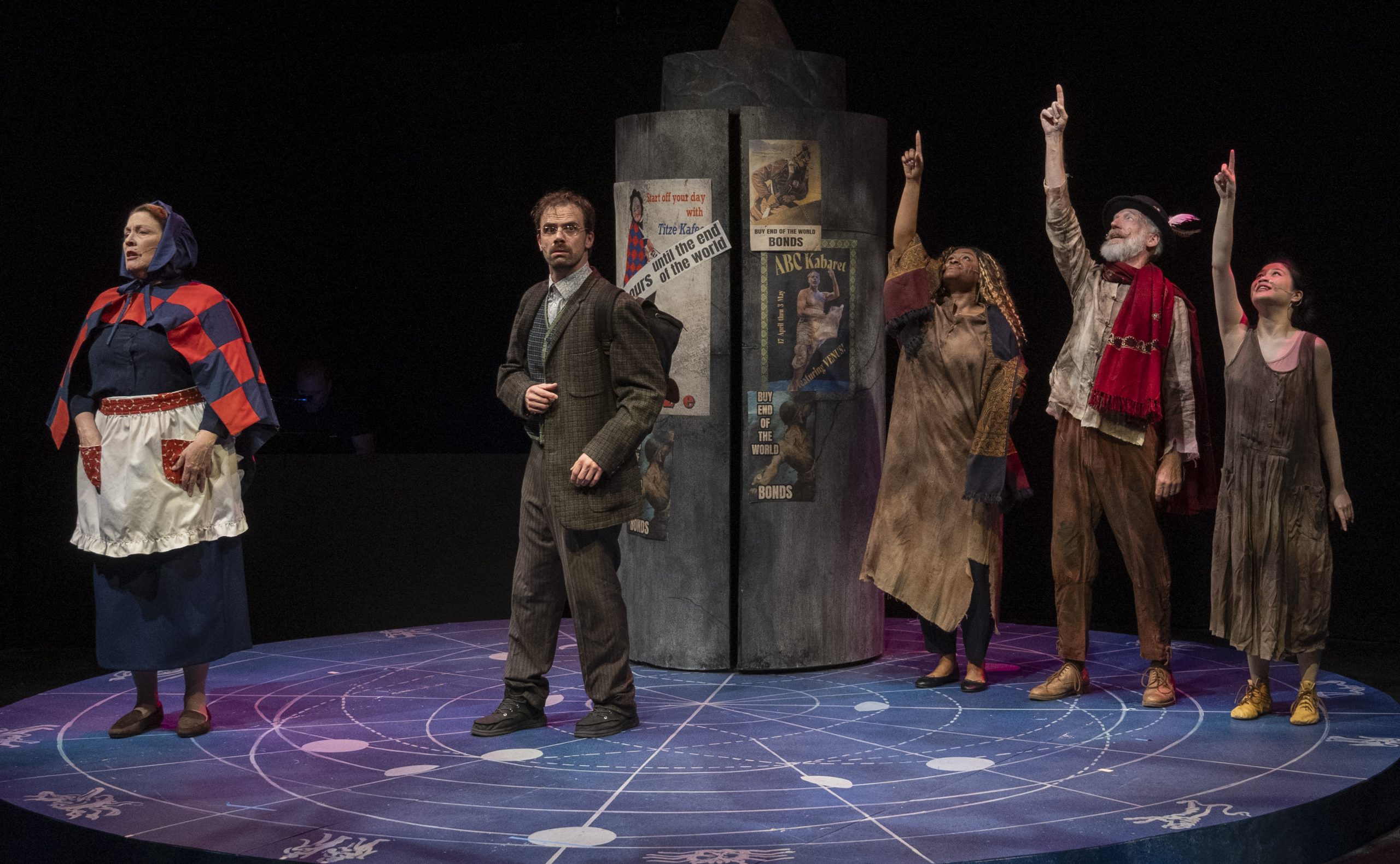
Jane Paradise as Sun (center) and cast as the planets, in Upstream Theater's "The End of the World Cabaret." Photo credit: Patrick Huber. Courtesy of Upstream Theater
Jane Paradise as Sun, with cast as the planets, in Upstream Theater's "The End of the World Cabaret." Photo credit: Patrick Huber. Courtesy of Upstream Theater
– By Cate Marquis –
Upstream Theater’s “The End of the World Cabaret” is a thought-provoking satire that mixes science fiction and a sense of the magical with humor, irony, and absurdity, in a tale about a world facing destruction but ignoring the genius scientist offering a solution to save the planet. The parallels to the present, on many levels, are striking, remarkable for something written in the 1930s, as authoritarian rulers marched the world towards World War II.
Jura Soyfer was 23-years-old when he wrote this bitingly funny science fiction satire, a young man born in Ukraine but living in Austria under authoritarian rule by dictator Kurt Schushchnigg and the Austro-fascist Fatherland Front. The play survived the war to come in various forms, adapted by Upstream Theater’s Artistic Director Philip Boehm. While a few updates were made, surprisingly prescient details, such as an American millionaire buying a seat on a spaceship to escape the destruction, were in the original.
It all begins with a dance of the planets, circling the Sun in spinning grace. But the harmony is somehow off, something is out of sync, and Sun’s stern gaze finally uncovers the problem: an Earth that has become unbalanced. The solution is the destruction of Earth, by a passing Comet which the Sun captures for that purpose. But a scientist on Earth has figured out a solution to deflect the comet and re-balance the Earth. He sets out to do that by appealing to the general public and then array of political leaders, who don’t quite get it. If only he can get some leader on Earth to listen and put the solution in action while there is still time.
This is the St. Louis premiere of a refreshed version of the play, in which the world is facing destruction but a scientist has the solution that will save it, if only he can get someone to listen to him. Sound familiar? Yes, but the existential threat that the people of Earth face in this play is different from the one the Earth faces in real life now, although the effect is much the same in this well-staged play.
It is easy to find parallels with other science fiction works dealing with the Earth’s current situation, particularly the satiric movie “Don’t Look Up,” yet this play predates the discover of global warming. Nonetheless, the tale of a desperate effort by a scientist to save the Earth by trying to convince leaders take action is as maddening as it is absurdly, darkly funny.
Director Lizi Watt creates a magical world for this tale to play out, aided by Patrick Huber’s flexible scenic design, Nola Buehler’s found-object costumes, and music and dance by Paige Brubeck (of Sleepy Kitty) and Dawn Karlovsky of Karlovsky and Company Dance, respectively.
It all starts a dance of the planets, dressed in a charming mix of mismatched costumes to capture their personalities, as they spin around their queen, the Sun (Jane Paradise), who directs to the celestial objects. The cast playing those planets, and Paradise, also play various roles as people on Earth, creating characters who are appealing, heartbreaking, charming or maddening, as the role requires.
Each planet has it’s own personality, expressed through costume, dance and even song: quick Mercury (Caitlin Mickey), steamy Venus (Isaiah Di Lorenzo), cold Mars (Patrick Blindauer), ponderous Saturn (Amarachi Kalu) and offbeat Pluto (Ashwini Arora). Earth is played by Sarah Wilkinson, with Moon played by John Flack. (The absence of Jupiter and Neptune are not explained). A visitor to the solar system, Comet, is played by Chris Ti pp as a kind of cosmic vagabond. Each actor also plays a variety of parts on Earth, except for Chris Tipp, who only plays the scientist Professor Peep who is trying to convince someone, anyone, on Earth to put in motion his plan to save the planet, before time runs out.
Convincing people that there is a problem is part of the problem but so is getting anyone to do anything. Apart from Tipp and Flack, each cast member plays one of the journalists who report on the problem, and even that there is a solution. They also play a variety of silly, absurd, self-absorbed people that Prof. Peep meets along the way: officials, street singers, a robber, a preacher, a millionaire, and even a couple of animals. The famous American Black opera star Marian Anderson (Caitlin Mickey) makes an appearance. Among Sarah Wilkinson’s many roles, she also plays the Fuhrer, who is a comic, egotistical blowhard with ambitions of world domination, yet unable to see the problem with that plan if there is no Earth.
While we laugh at the ridiculous characters, we are horrified at the same time, as Prof. Peep becomes increasing frustrated and then despondent as the time ticks away. Despite out expectations, the play ends on a hopeful note, which helps us out, as we return to the dance of the planets around the Sun.
Upstream Theater’s production of “The End of the World Cabaret” is on stage at the Marcelle Theater, 3310 Samuel Shepard Dr., through May 3, 2026.
© Cate Marquis
- By Cate Marquis - The Muny decides to wrap up it's 2026 season with…
(L-R) Sam Harvey as Sky Masterson and Matthew Schatz as Nathan Detroit in Stages' "Guys…
- By Cate Marquis - New Jewish Theater's "Job" is a searing two-person drama set…
Gregory Lee Rodriguez and Kyla Stone, in the Muny's MEET ME IN ST. LOUIS. Photo…
Matt Newlin as Tennessee Williams, in First Run Theater's TENN at the Kranzberg. Courtesy of…
(L-R) Nick Rashad Burroughs, Jawan M. Jackson, Elijah Ahmad Lewis, James T. Lane, Daniel Yearwood…