– By Cate Marquis –
New Jewish Theater’s “A Prayer for the French Republic” is a wide-ranging, even epic family drama, spiked with moments of humor, about an extended French Jewish family who have been in France for a thousand years and operated a Parisian piano store for generations, dating back to the mid-19th century. Having barely survived Nazi occupation, the family is now facing a new changing situation, for the piano business and for Jews in France, which leads the generation-spanning discussions about the family’s future.
“A Prayer for the French Republic” toggles back and forth between a recent present and Paris under Nazi occupation from the family’s point-of-view, but with references to the family’s long history in France, the first European country to grant Jews full rights, with the French Revolution. The title references the tradition in Jewish schools of a prayer to recognize that history, a practice that comes under question in the course of the play.
Of course, the impact of the Holocaust and Nazi occupation of France are among the subjects explored in this wide-ranging family drama, it is less about WWII than it is the larger sweep of Jewish history in France and, especially, contemporary issues like the rising tide of antisemitism. All is seen through the lens of this family’s history.
While there are scenes of family dynamics drama and moments that are laugh-out-loud funny, “A Prayer for the French Republic” deals with topics that are timely and very of the moment, like rising antisemitism and violence against Jews, in France but also across Europe and even here. This wider focus makes the drama more timely and both universal and specifically Jewish, even French Jewish.
Playwright Joshua Harmon, who has French Jewish roots, began writing his play in 2016, not so long after France was rocked by the Charlie Hebdo attacks, post-Trump’s election but pre-pandemic, and he then continued to work on it until its premiere in 2022. With recent antisemitic attacks in the U.S. and Europe, this play couldn’t be more timely, even though a portion of it takes place during WWII and the post-war period. Those wartime and post-war experiences are discussed but so are a wide of other subjects of concern to present-day Jews here and in France, such as rising antisemitism but also topics such as a family facing changes to the multi-generation family business of selling (and once manufacturing) pianos, the shift in France from mostly Ashkenazim Jews whose families have been French for generations to Sepharic Jewish families from Morocco who have less history in France, considerations in whether one should be secular or observant, and how public that should be, especially in a time of rising antisemitic violence.
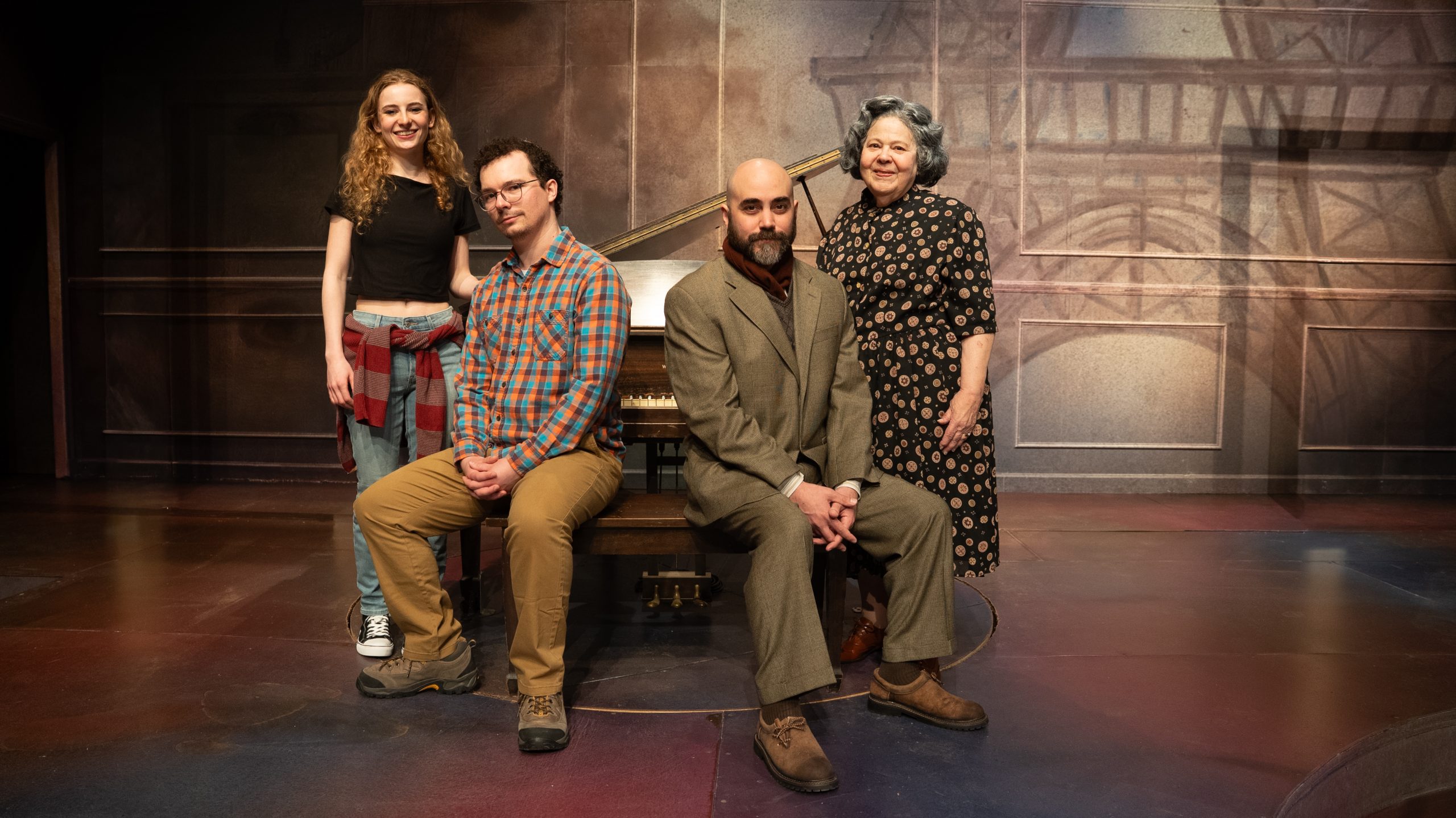
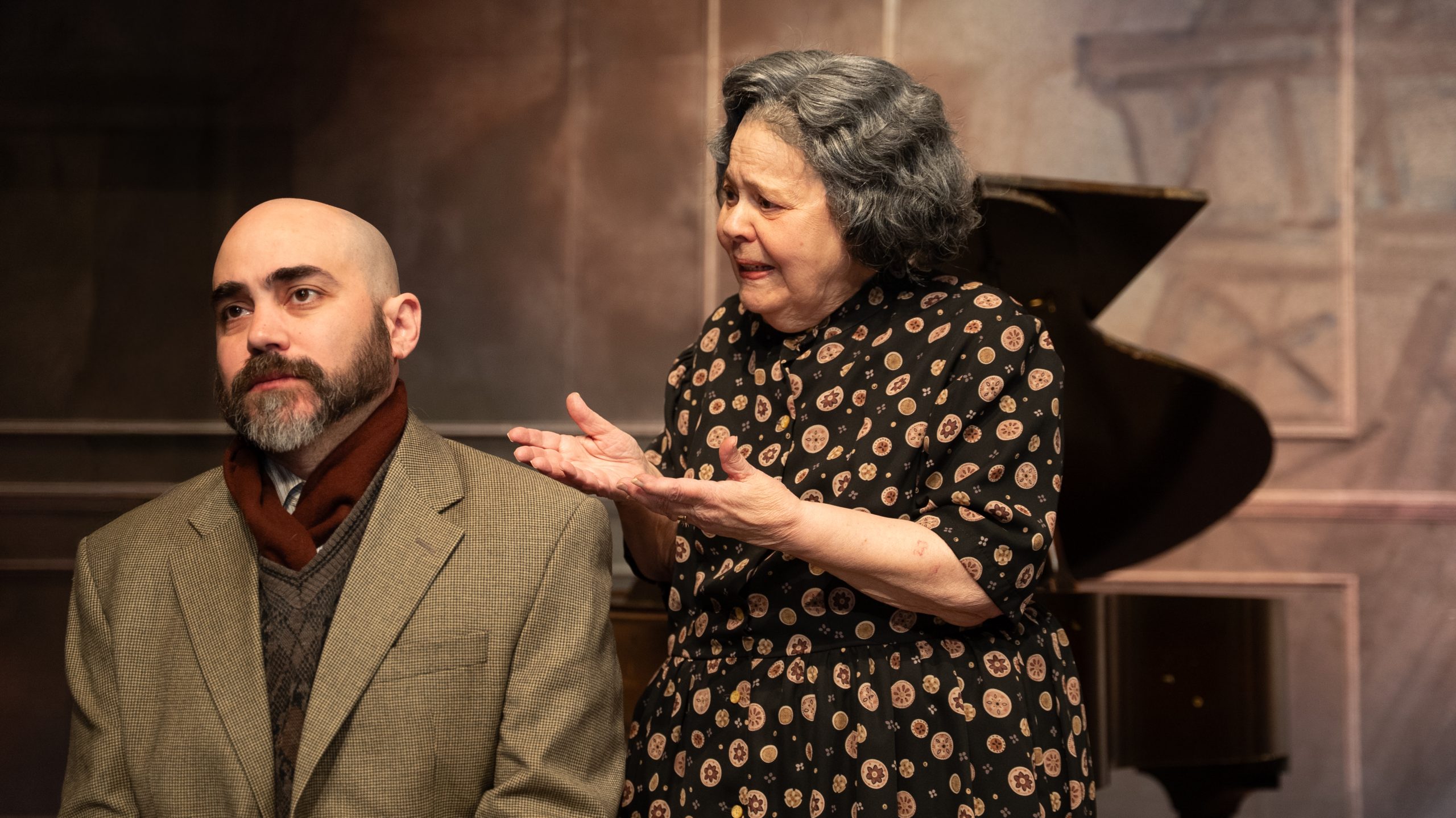
The play has a large cast of characters, and the play’s program helpfully includes a Salomon family tree to keep everything clear. A central focus is the matriarch of the modern story, Marcelle Salomon Benhamou (Jenni Ryan), who is described as someone who is quintessentially French. Marcelle is the daughter of Pierre Salomon (Will Shaw at the performance this reviewer saw, Bob Harvey at other ones) and the play’s sometime narrator is her brother Patrick Salomon (John Wilson). Marcelle’s husband is Charles Benhamou (Dave Cooperstein), from a family of Moroccan Sephardic Jewish descent, and their children are brilliant, tart-tongued daughter Elodie (Hailey Medrano) and son, Daniel (Bryce A. Miller), a gentle soul who has become observant despite his mostly secular upbringing. Daniel’s faith has brought Marcelle’s family back to some traditions, like for the sabbath, despite brother Patrick’s disdainful attitude. A visitor from America, Molly (Lilah Kreis), a distant Salomon cousin descended from Marcelle’s great-grandmother Irma’s sister, completes the contemporary family circle.
In the part of the play set in the past, the grandparents of Marcelle’s and Patrick’s father Pierre, Irma (Kathleen Sitzer) and Adolphe (Bill Stine) Salomon survived the Nazi occupation of Paris by being undetected in their apartment, while their son Lucien (Adam Flores) and his family were not so lucky, rounded up and sent to a concentration camp. Only Lucien and his young son Pierre survived and made it back to the family home. Lucien is determined to keep the piano store in operation, and wants his son joins him there.
The play is directed by Rebekah Scallet, NJT’s Artistic Director, and she does a fabulous job with a epic tale that might have overwhelmed another director. The story all takes place on a single set, representing in the family’s Paris apartment, but moving back and forth between 2016-2017 and 1944-46 presents some challenges, which Scallet deftly handles this by using a grand piano on a turntable, which faces one way for the modern portion and the opposite way, revealing an assortment of old family photos for the 1940s portion. The solution is cleverly and clearly signals the switch to the audience.
Much of the story revolves around the Salomon family’s multi-generation business of selling pianos (and even manufacturing them at one point). It began in the mid-19th century, and was once a prestigious and lucrative enterprise, when a piano was an essential part of every middle-class home and even a signal of “having arrived” in the middle-class. But tastes and traditions changed, and the invention of radio and phonographs in the 20th century began the family business’ decline. By the post-war 1940s, running the piano store was a lonely, one-man operation, a family tradition rather than a money-making business.
That bit of history of the piano business illustrates the ambitiously broad number of subjects touched on in this family drama, as well as its mix of personal, familial, cultural, specifically Jewish, specifically French and universal subjects discussed.
Dazzling dialog and sharp-witted (and often sharp-tongued) discussions that fearlessly dive into his pool of topics are one of the primary delights of this play. Another are the performances, in sharply drawn characters who represent various viewpoints as well as being unique people. The large cast allows for a range of discussion types, and referring back to the past deepens many of those gripping discussions. The play’s length, three hours with two intermissions, allows enough depth of discussion to make it feel satisfying and complete. , covering its ambitious array of topics. is ambitious but the dialog is dazzling, with discussions that are gripping and sharp-witted, and an array or viewpoints debated with brilliance.
Despite it’s length, “A Prayer for the French Republic” is a wonderful immersive theater experience, exploring French Jewish culture and the debate on a vast range of timely topics, involving discussions all done through well-written dialog and fascinating characters. Once again, NJT has shown masterful skill in choosing a great play and presenting it in a way to effectively bring the audience into its world.
New Jewish Theater’s “A Prayer for the French Republic” is on stage at the Jewish Community Center’s Staenberg Family Complex theater, 2 Millstone Campus Dr., Creve Coeur, MO, through May 3, 2026.
© Cate Marquis